
Product Governance Policy
1. Scope and Purpose
Aioi Nissay Dowa Insurance Company Australia Pty. Ltd. underwrites a variety of different retail and wholesale products. For the purposes of this Product Governance Policy, “we” and/or “our” references Aioi Nissay Dowa Insurance Company Australia Pty. Ltd.
As signatories to the General Insurance Code of Practice, we are committed to playing our part in raising the standard of practice and service across the insurance industry in Australia. We also want to make sure that anyone who purchases insurance with us is receiving a quality product which is likely to offer protection suitable for their circumstances, requirements and financial situation.
Our Product Governance Policy helps to ensure that:
- We identify the types of customers who are most suited to our products, and likely to receive good value from them (our Target Markets)
- The products we offer are always designed with a clear focus on the needs of those Target Markets
- We and our distribution partners adopt processes to ensure our products are only offered to those intended customers, and that we avoid selling products to people who are unlikely to receive good value
- We have robust procedures in place to help us monitor and regularly review the sale and performance of our products, so that we can identify any issues that may suggest a product could be improved, or is being sold to customers who are not benefiting from it
- Whenever we find opportunities to improve, we take actions to enhance the design of our products, and/or the method in which we are selling them
Our Product Governance Policy also demonstrates our commitment to meeting our product design and distribution obligations, and describes what we do to make sure we meet those obligations, including the implementation of a Product Governance Framework.
2. Product Governance Framework
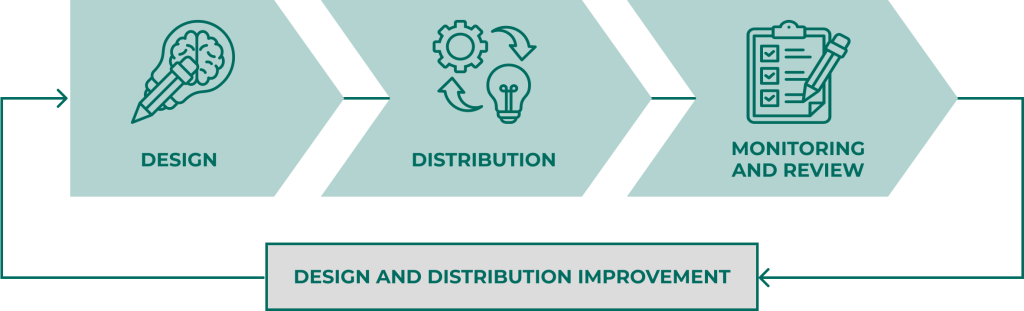
The three stages in our Framework are ‘Design’, ‘Distribution’ and ‘Monitoring and Review’. When we identify opportunities for improvement during the Monitoring and Review stage for a particular product, we adjust the product’s design and distribution features accordingly.
2.1 The Design Stage
During the Design stage we:
- Identify and define the Target Market for the product
- Utilise data, engage with stakeholders, perform risk assessments and seek approval from our Product and Underwriting Committee, to feed into our product and Target Market design, so we can be confident the product will provide good value to customers while also helping us to achieve our business objectives
- Test our systems to confirm they will manage the product successfully and securely
- Determine the signs or ‘review triggers’ we will look out for to help identify any misalignment between the product and the Target Market
- Set a review schedule which confirms the timeframes for post-launch review, and regular monitoring of the product’s performance
2.2 The Distribution Stage
During the Distribution stage we and our distribution partners:
- Make sure potential customers have an opportunity to consider whether they fit the Target Market for the product under consideration
- Do not sell our product to any segment of customers which we are aware do not fit within the Target Market
- Share information which will help us to determine how well our product is aligned to the designated Target Market,
- Communicate regularly to help verify the effectiveness of our processes, identify any concerns with the sale of our product or its appropriateness for the Target Market, and ensure we and our partners are well aligned in our approach to the product’s distribution
2.3 The Monitoring and Review Stage
During the Monitoring and Review stage we:
- Follow the schedule we have set for regular monitoring and review of our product’s success, looking at information such as loss ratios, sales figures, cancellation trends, and the number and nature of complaints and declined claims
- Identify if any of the ‘review triggers’ we have set are met, and conduct a review of the applicable product and/or Target Market
- Present reporting outcomes and confirm plans to address any identified issues at our regular Product and Underwriting Committee meetings
- Improve the design and/or distribution processes for the product, where appropriate
- Redefine a Target Market if determined as necessary
We will also periodically review our Product Governance Framework to evaluate its effectiveness, and we will make updates and improvements whenever we identify opportunities to increase the benefit it provides to us and our customers.
3. Our Product Governance Structure
We have a Product and Underwriting Committee (PUC) which exists to provide clear oversight to key stakeholders across our business regarding our product development and underwriting functions. The PUC is responsible for approving our approach to key product and underwriting matters, including the approval of our Product Governance Policy and Product Governance Framework. The PUC must also review and provide recommendations to the Chief Executive Officer for any new products we develop, and any changes to existing products or Target Markets.
The Product and Underwriting Committee typically convenes at least once a quarter, or otherwise as required, and is comprised of our:
- Chief Executive Officer
- Chief Coordinating Executive
- Chief Actuary and Product Officer
- Chief Operating Officer
- Chief Financial Officer
- Risk and Compliance Manager
The Senior Product Manager and Senior Manager – Sales and Promotion also attend all PUC meetings in an advice-giving capacity, to provide relevant experience and expertise as required.