Modern Slavery Statement
About Us
Adica is wholly owned by Aioi Nissay Dowa Insurance Co., Ltd part of the global MS&AD Insurance Group Holdings Inc. We are proud to uphold the values of our global parent, which is a signatory to the UN Global Compact and has a strong commitment to human rights, including preventing human rights abuses within value and supply chains
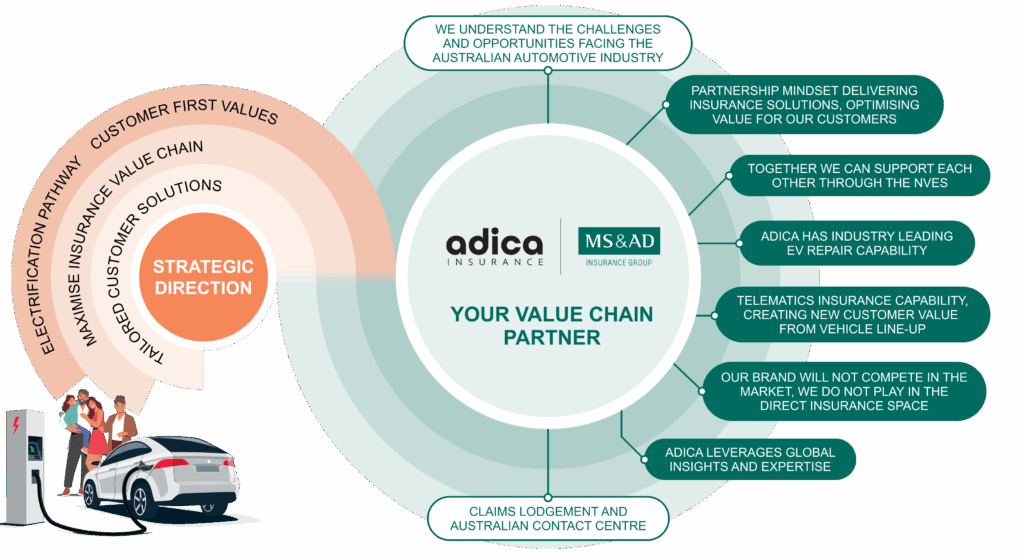
Adica strength in the Australian market is underpinned by specialisation and expertise in retail automotive insurance. With this knowledge, we support out business partners to transform the value chain of insurance for customers.
We are focused on serving the Australian market in three key insurance sectors:
- Retail Motor
- Fleet Motor
- Dealer House Accounts
In both 2024 and 2025, we were awarded the ANZIFF Small-Medium General Insurance company of the year. We were also selected as Employer of Choice in the Australian Business Awards 2024.
Our Values
Our values define and guide our decisions and shape our interactions with each other, our customers, our distributors and our community. The Adica five core values serve as the foundation for the behaviours expected from all Adica employees. When employees consistently align their actions with Adica’s values, it strengthens our ability to operate effectively and meet our strategic objectives.
- Customer – we think customer.
- Innovation – we lead the way.
- Professionalism – we are experts in what we deliver
- Teamwork – together we make a difference.
- Integrity – we do the right thing
These values are integral to the way we do business. They are there as a reference point if you’re ever unsure about a decision. If you are working with these values as your guidelines, you will have the support and confidence of Adica behind you.
Our Committment
Our statement covers the activities implemented by Adica to minimise the risk of modern slavery and human trafficking pursuant to the Modern Slavery Act 2018 (Cth) (Act) in the year commencing 1 January 2024 and ending 31 December 2024 (Reporting Period).
We are committed to preventing acts of modern slavery from occurring within our operations and supply chains. We maintain a stringent risk management framework and a Modern Slavery Policy to ensure that we facilitate a collaborative and safe workplace for our employees and workers in our supply chains.
Our Operations
- Toyota Insurance;
- Lexus Insurance; and;
- PowerTorque Insurance;
We also provide commercial fleet and industrial special risk insurance to hundreds of small to large businesses, where we insure over $11.7 billion in business assets.
Our main business functions include Claims & Service and Product Design, supported by Human Resources, Finance, Risk, Governance & Legal, Strategy & Partnerships, Project Management & Technology.
We employ approximately 280 full-time, part-time, fixed-term and casual employees throughout Australia and secondee team members to our business from our business partners. We also contract a number of team members in the Philippines and India via Australian-based companies.
We are committed to ensuring that employment conditions for our employees and team members meet minimum wage, appropriate hours of work and leave provisions. We conduct remuneration reviews annually to ensure our employees are paid in accordance with their contract of employment and the applicable wage standard and award. All employees and team members complete our code of conduct training and modern slavery training annually.
We have carried out a modern slavery risk review of our workforce, and determined there is a low level of modern slavery risk in relation to our employees and team members.
Our Code of Conduct
Our Code of Conduct sets out the values, ethics, and standards we expect from all employees. It serves as a guide to help everyone understand their responsibilities and obligations while working at Adica.
A positive workplace culture is essential to our success. This Code highlights the behaviours we expect in how we approach our work and how we interact—with each other, our customers, distributors, and the broader community.
While the Code provides clear guidance, it is not a substitute for good judgement. It reflects the shared principles that underpin how we conduct ourselves and our business every day, including those that underpin our commitment to stamping out modern slavery.
Our Supply Chain
These suppliers are typically located in Australia and include the following:
- professional service providers;
- information technology providers;
- property facilities management and office solutions;
- banking and finance;
- human resources such as recruiters;
- employee travel and accommodation; and
- claims suppliers.
Supplier Due Diligence and Assessement
As part of our procurement process, we conduct due diligence on all prospective and new suppliers. For existing suppliers, we undertake ongoing monitoring to ensure the standards we expect from our suppliers have been maintained, in accordance with our third-party oversight framework. This includes undertaking due diligence of suppliers to review modern slavery risk and conducting annual reviews of suppliers modern slavery frameworks (where applicable).
Our procurement and third-party oversight frameworks requires us to conduct a risk assessment for each of our suppliers. Our procurement framework includes a requirement for all suppliers (where the procurement cost is over $500.00) to complete a modern slavery risk assessment. Any potential modern slavery risks that are identified during this initial stage through analysis of the supplier’s overall modern slavery risk profile (Risk Analysis). The Risk Analysis includes the following consideration:
6.1 Industry Risk
Certain sectors or industries may have higher inherent modern slavery risk because of their practices, haracteristics, products and processes.
6.2 Region Risk
Certain countries, regions or jurisdictions may have higher inherent modern slavery risk due to conflict, rule of law or limited regulation.
6.3 Dollar Value Risk
The modern slavery risks based on the importance and value of the relationship between us and the supplier.
Additionally, factors such as the supplier’s profile and governance arrangements, cost of the arrangement, and use of sub-contractors are identified.
Following the Risk Analysis, if we determine that any of our suppliers have a potential modern slavery risk outside of our appetite, we will undertake a further assessment to determine the risk level and rating (high, medium, or low risk).
2024 Risk Analysis
Over the course of the Reporting Period:
- We completed a risk assessment of 27 new suppliers to Adica.
- We reviewed and rated the responses to the questionnaires to identify higher risk suppliers.
These suppliers include information technology providers, claims suppliers and office solutions who utilise services or manufacture and purchase their products from regions where the risks of modern slavery occurring are reported to be comparatively higher.
Our 2024 Risk Analysis concluded that the majority of our suppliers in 2024 and their respective supply chains present a low level of modern slavery risk.
Further, in 2024, we received no complaints raised in relation to Modern Slavery Risks in our supply chain.
Our Responsibility
We are committed to preventing acts of modern slavery from occurring within our operations and supply chains. If one of our suppliers is involved in a modern slavery complaint, we will work with all affected parties to address the issue in a fair and timely manner and investigate the complaint thoroughly.
In the event a complaint is raised, we would take steps to review our relationship with the supplier and determine the appropriate remediation steps to be taken, with consideration given to whether we should end our relationship with the supplier.
Our Actions to Detect and Combat Modern Slavery Risks
- Annual reviews of our governance frameworks; and
- Employee training and protections.
These examples are discussed in detail below.
We have a strong suite of governance frameworks and corporate policies that assist us to maintain a strong risk culture. Our risk and governance department, along with other accountable business units, annually review our corporate policies and processes to ensure they effectively protect us from a variety of risks. This includes our Modern Slavery Policy, Third party oversight and procurement frameworks.
We also promote a “speak up” culture, which enables our employees to feel comfortable to raise issues and concerns across all areas (including modern slavery risks).
The MS&AD group is committed to Human Rights, and we developed a policy, designed to promote a work environment that upholds and respects the fundamental principles of human rights. It outlines the responsibilities of Adica as an organisation within the MS&AD group with respect to both community and social responsibility, as well as the responsibility of our employees to ensure compliance with human rights laws. When creating our policy, we considered the Act and our commitments made in our modern slavery statement.
To protect our employees against modern slavery risks we:
- require all employees to undertake annual modern slavery training;
- conduct regular work health and safety checks including on-premises and home office; and
- conduct annual reviews to assess remuneration against changes in the market and applicable legislation.
We encourage our employees to report any genuine concerns about modern slavery within our operations or supply chains.
Assessing the Effectiveness of our Actions
After conducting our annual review of modern slavery risk processes, we found that our identification and mitigation strategies effectively tackle potential risks within our supply chain with consideration to our business size and complexity. These efforts are supported by our strong corporate governance protocols and ongoing employee training, which supports our values to minimise modern slavery risks. Encouragingly, in 2024 we observed no escalation in the level of modern slavery risk within our supply chain.
Additional Actions to Combat Modern Slavery Risks
In our FY2023 Modern Slavery Statement, we committed to continually reviewing our modern slavery and governance frameworks to ensure they remain effective in identifying and addressing modern slavery risks.
As part of this commitment, we began a review of our procurement and third-party oversight frameworks, which is expected to be finalised in 2025. A key focus of this review is ensuring that our framework adequately addresses modern slavery risks.